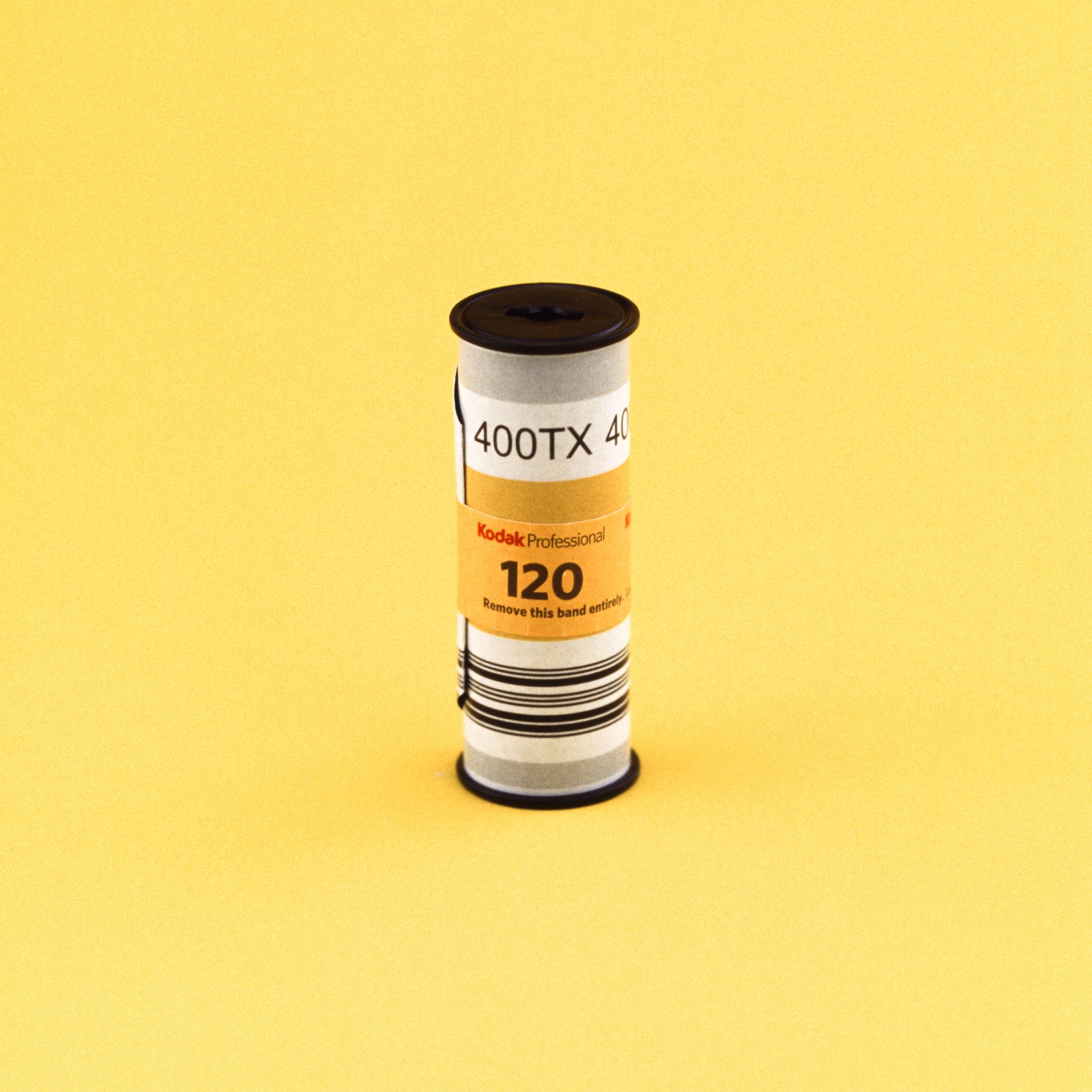
Kodak TMAX 400 - 120 Film


Kodak TMAX 400 - 120 Film
Kodak TMAX 400 – 120 format panchromatic black and white negative film
ISO 400 — standard black and white development
T-GRAIN emulsion — finest grain structure of any ISO 400 B&W film
Very high sharpness with excellent edge detail and resolving power
Wide exposure latitude — rate up to EI 1600 with push development
Broad tonal range optimised for scanning and large-format enlargement
More clinical and precise than Tri-X — a different kind of B&W
Best for: studio portraiture, architecture, landscapes, and any situation demanding maximum technical quality in B&W
Kodak TMAX 400 120 Film
Kodak TMAX 400 in 120 is the most technically accomplished black and white film you can put through a medium format camera. The T-GRAIN emulsion delivers the finest grain structure of any ISO 400 black and white film in production, and in a 120 negative that already has four to ten times the area of a 35mm frame, the results are extraordinary — grain that virtually disappears, resolution that approaches the limits of the optics in front of it, and a tonal range that holds every step from the deepest shadows to the brightest highlights with precise, even rendering.
It is a film with a clear purpose and a specific character. If you want the finest possible technical quality from your medium format system in black and white, TMAX 400 in 120 is the answer.
Why photographers love Kodak TMAX 400 in 120
TMAX 400 doesn't have the gritty personality of Tri-X or the easygoing versatility of HP5 — it has precision. The T-GRAIN emulsion is a fundamentally different technology to conventional silver halide grain, using tabular crystals that pack more efficiently and expose more uniformly. The result is a grain structure that is genuinely fine for ISO 400, with a smooth, almost digital-looking quality that divides opinion but is uniquely well-suited to certain kinds of work.
In 120, those qualities become even more pronounced. Studio portrait photographers use it because it resolves fine detail — skin texture, fabric, hair — with a clarity that no other ISO 400 B&W film can match. Architecture and landscape photographers use it because the broad tonal range and high resolving power make enlargements look exceptional. Scientific and technical photographers use it because the consistent, predictable response is exactly what controlled work demands.
It also pushes well. Rated at EI 800 it remains clean and highly detailed. At EI 1600 grain becomes more visible but still significantly finer than most films at box speed. For medium format photographers who need both speed and quality in low light — documentary work, available-light portraiture, theatre — TMAX 400 pushed in 120 is a remarkably capable combination.
Camera pairings: Hasselblad 500 series, Mamiya RB67, Mamiya 645, Pentax 67, Bronica ETRS, Rolleiflex — any medium format system benefits from what TMAX 400 brings. Its scanning performance in particular rewards the combination of a quality medium format lens and a good scan.
A bit of film history
Kodak introduced the TMAX family in 1986 with TMAX 100, followed by TMAX 400 and TMAX 3200 — collectively representing a significant technological shift away from conventional cubic-grain emulsions. The T-GRAIN technology was genuinely new and initially controversial among photographers accustomed to the character of traditional films. Over time, TMAX 400 has earned a devoted following among technically-minded photographers who prioritise resolution and grain control above all else. A reformulation in 2007 further improved the emulsion's pushing characteristics and scanning performance, and the current version is considered the finest iteration the film has ever been.
Processing
Kodak TMAX 400 requires standard black and white negative processing, though it performs best with developers designed to complement T-GRAIN emulsions — Kodak XTOL, D-76, and Kodak's own TMAX developer all suit it well. We process black and white in-house at Ikigai Film Lab in Melbourne, with scanning available on our Fujifilm Frontier and Noritsu HS-1800 scanners. If you're pushing, note your rated ISO on your order so development time can be adjusted accordingly. TMAX 400 scans exceptionally well — the fine grain and high resolving power make the most of quality scanning equipment.
Common questions
How does Kodak TMAX 400 120 compare to Kodak Tri-X 400 120?
They're the two great Kodak ISO 400 black and white films and they represent opposite ends of the B&W aesthetic spectrum. TMAX 400 is precise, fine-grained, and technically controlled — its grain is smooth and almost understated, and its tonal rendering is even and detailed. Tri-X is grainier, more contrasty, and has a rawer, more expressive character that many photographers find more emotionally engaging. TMAX is the choice when technical quality is the priority. Tri-X is the choice when character is the priority. In 120 format, both are exceptional — TMAX pushes the technical ceiling, Tri-X delivers a look that medium format photographers love precisely because the larger grain becomes a design element rather than a flaw.
How does TMAX 400 compare to Ilford HP5 Plus in 120?
HP5 is smoother and more forgiving than Tri-X but still has a traditional grain character compared to TMAX's T-GRAIN technology. HP5 has more exposure latitude and a more relaxed tonal curve that suits a wide range of subjects. TMAX 400 has finer grain, higher sharpness, and better push performance, but a more demanding curve that rewards precise exposure. For most photographers HP5 is the easier and more versatile film. For photographers who specifically want the finest grain and highest resolution from their ISO 400 B&W stock, TMAX 400 is the better technical choice.
How far can I push TMAX 400 in 120?
TMAX 400 pushes well to EI 800 (one stop) and EI 1600 (two stops) with very good results. The T-GRAIN emulsion maintains better grain control at pushed speeds than most conventional emulsions, which is one of its genuine advantages. At EI 3200 (three stops) results are more variable and developer choice becomes important — XTOL and TMAX developer are the best options at extreme pushes. Always note your rated ISO on your processing order.
Is TMAX 400 good for portraits in 120?
Yes — particularly studio or controlled-light portraiture where the combination of fine grain, high sharpness, and broad tonal range produces exceptional results. The smooth grain doesn't call attention to itself the way Tri-X does, which suits photographers who want the medium format negative to speak for itself. For environmental or documentary portraiture where a more expressive, textured look is the goal, Tri-X or HP5 may suit the aesthetic better.