Ilford XP2 400 - 35mm - 36 exp

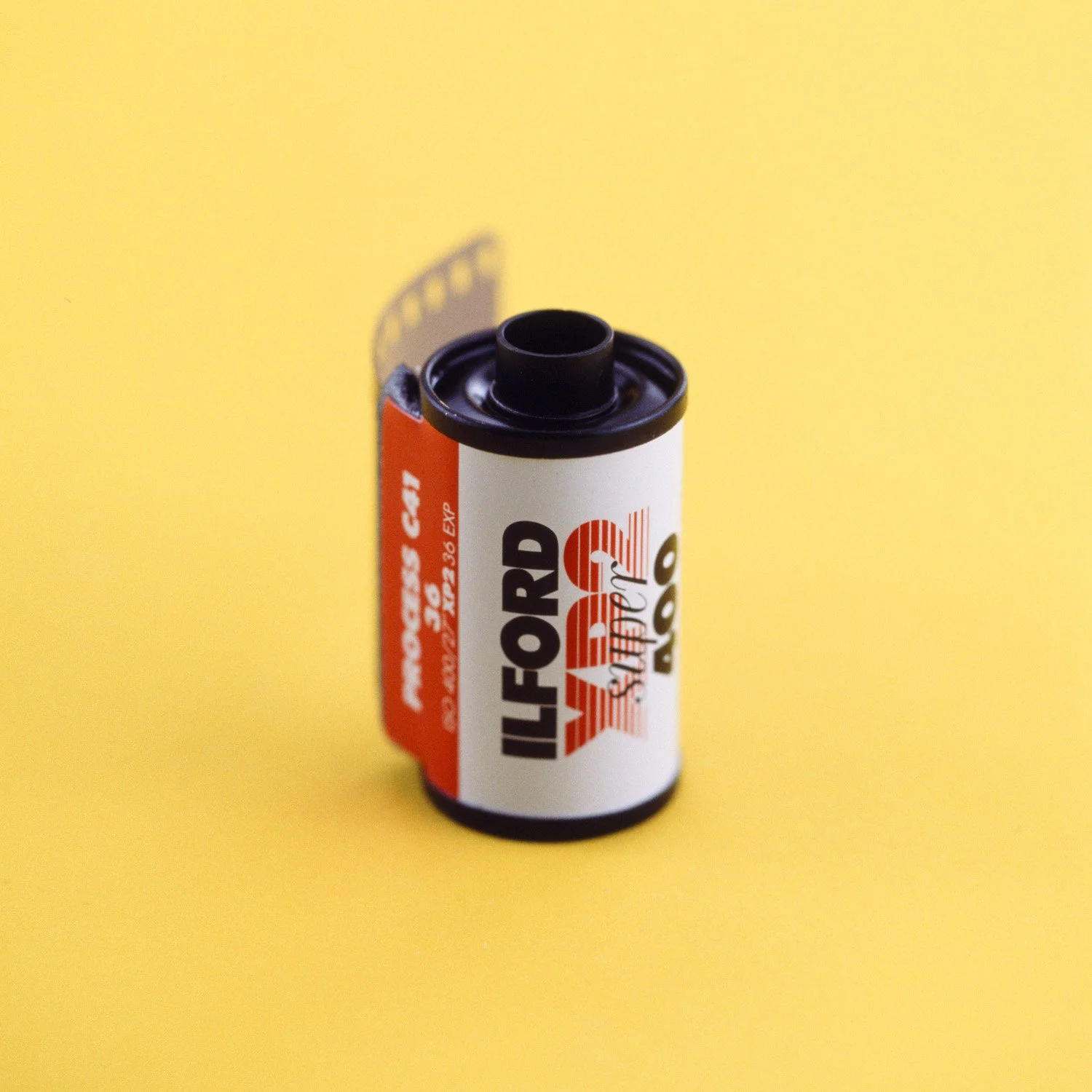
Ilford XP2 400 - 35mm - 36 exp
Ilford XP2 Super – 35mm chromogenic black and white negative film, 36 exposures
ISO 400 — processed in standard C-41 colour chemistry (not B&W chemistry)
Extremely wide exposure latitude — usable from ISO 50 to ISO 800 in a single roll
Very fine grain structure with high sharpness — among the finest grain of any ISO 400 B&W film
Grain character changes with exposure rating — finer at lower ISOs, more pronounced at higher
Can be printed on traditional B&W papers or RA-4 colour papers
DX-coded cassette, 36 exposures
Best for: photographers who want B&W processed alongside colour, travel, and shooting across wildly variable lighting conditions
Ilford XP2 Super 35mm Film (C-41)
Ilford XP2 Super is the most practical black and white film in existence. It's a chromogenic film — meaning it uses colour dye technology rather than conventional silver halide — and it processes in standard C-41 colour chemistry. The same chemistry as every colour negative film you've ever shot. You can drop XP2 in with a roll of Portra, a roll of Gold 200, and a roll of Superia, and they all come out together in the same development tank.
For photographers who shoot mostly colour but occasionally want black and white, this is transformative. No separate B&W processing order, no extra cost, no waiting. Your XP2 comes back with your colour rolls, scanned and ready.
Why photographers love Ilford XP2 Super
The most useful quality of XP2 — beyond the C-41 processing — is its extraordinary exposure latitude. Ilford specifies it as usable from ISO 50 to ISO 800 on a single roll with no push or pull development required. That's an almost unheard-of range for any film. In practice it means you can shoot XP2 in harsh noon sun and dim indoor light on the same roll, develop it normally, and have usable negatives across the entire range.
The grain character also responds to how you rate it, which gives you a degree of creative control that's unusual for a consumer-oriented film. Rated at ISO 400 — box speed — you get the most neutral balance of fine grain and high sharpness. Rate it lower at ISO 200 or 100 and the grain becomes even finer, almost impeccably smooth, with slightly compressed contrast. Rate it at ISO 800 and the grain opens up, contrast increases, and the images take on a more dramatic, higher-contrast character. One film, multiple looks, all from adjusting your ISO dial.
The grain itself is distinctive — finer and smoother than HP5 or Tri-X at equivalent speeds, with a quality that some photographers find too clean and others find liberating. It doesn't have the gritty character of traditional silver-based B&W films. It's its own thing: precise, smooth, and very well-suited to scanning.
Camera pairings: it works beautifully in any camera, but shines particularly in point-and-shoots where C-41 processing is the default — Canon Sure Shot, Olympus Stylus, Nikon L35AF. For travel photographers who want the option of B&W without managing a separate processing stream, it's ideal.
A bit of film history
XP2 was introduced by Ilford in 1980 as one of the first chromogenic black and white films, alongside Kodak's own VR series. It's been refined several times since — the "Super" designation arrived with a reformulation that improved grain structure and processing consistency — and has remained in production continuously for over four decades. It occupies a genuinely unique position in the film market: the only chromogenic black and white film still being produced in 35mm by a major manufacturer, and one that has no real competitors for what it does.
Processing
Ilford XP2 Super processes in standard C-41 chemistry — the same as any colour negative film. We process C-41 in-house at Ikigai Film Lab in Melbourne, with scanning available on our Fujifilm Frontier and Noritsu HS-1800 scanners. No special instructions needed — just include it with your colour roll order and it'll be processed at the same time. Note that XP2 should not be processed in standard black and white chemistry; it requires C-41.
Common questions
Can XP2 really be processed with my colour rolls?
Yes — completely. XP2 uses C-41 chemistry, the same as all colour negative films. You can include it in the same processing order as your colour rolls and it'll be developed identically. The scans come back as black and white images. This is the film's single most practical advantage and the main reason many photographers choose it.
What ISO should I rate XP2 at?
Box speed is ISO 400, which gives the most neutral balance of grain and sharpness. But XP2's enormous latitude means you can rate it anywhere from ISO 50 to ISO 800 without push or pull development. Lower ratings give finer grain and slightly softer contrast. Higher ratings give more pronounced grain and more dramatic contrast. There's no wrong answer — it depends on the look you want and the light you're shooting in.
How does XP2 compare to Ilford HP5 Plus?
HP5 is a conventional silver-based B&W film processed in B&W chemistry — it has a traditional grain character that many photographers love for its expressiveness and warmth. XP2 is chromogenic, processed in C-41, with finer grain, a smoother tonal rendering, and radically more exposure latitude. HP5 has more personality; XP2 has more precision and far more practical convenience. They suit different photographers and different workflows.
Does XP2 look different from conventional B&W film?
Yes — the grain is smoother and more regular than traditional silver grain, which gives XP2 a slightly cleaner, more contemporary look. Photographers who love the raw, textured quality of Tri-X or even HP5 often find XP2 too polished. Photographers who prioritise technical quality and practical workflow often find it exactly right. It's worth shooting a roll to see whether its character suits your aesthetic.
Can I print XP2 in a darkroom?
Yes — it's designed to print on both traditional black and white papers (using Multigrade contrast filters) and RA-4 colour papers with maintained print neutrality. It's a genuinely versatile film for darkroom work as well as scanning.