
Who Actually Makes Ilford Colour Film?
The Truth About Ilfocolor
If you’ve seen Ilfocolor sitting on a shelf beside HP5, FP4 and Delta 400, you’d be forgiven for assuming it was simply Ilford’s colour-film range. The branding makes that an easy conclusion to reach, particularly when the Ilford name has been synonymous with black and white photographic film for generations.
The problem is that the people behind Ilfocolor are not the people making HP5.
Modern Ilford black-and-white film is manufactured by HARMAN Technology at its factory in Mobberley in the UK. That is where HP5, FP4, Delta, Kentmere and the other films most photographers associate with Ilford are actually made.
“Ilfocolor” now comes from a completely separate branch of the old Ilford business.
In 2013, C.R. Kennedy and Chugai Photo Chemical acquired the assets and trademarks of the former Ilford Switzerland operation and established Ilford Imaging Europe. As part of that acquisition they obtained the rights to use the Ilford name for colour film products, along with other products such as inkjet papers and digital cameras.
That distinction becomes pretty important once you look at what is actually inside the boxes.
HARMAN cannot use the Ilfocolor name
The easiest way to understand how separate these businesses really are is to look at HARMAN’s own colour film.
HARMAN now develops and manufactures colour film at Mobberley under the HARMAN Phoenix name. It has the factory, the chemists, the coating machinery and the people who actually make Ilford black-and-white film, yet it still cannot sell Phoenix as Ilford because, as HARMAN itself explains, it does not have the rights to use the Ilford name for colour products.
So we’ve ended up in the slightly absurd situation where the company physically manufacturing what people identify as Ilford products cannot put Ilford on a colour film it develops and coats itself, while C.R. Kennedy and its partners can put the Ilford name on colour film.
So do C.R. Kennedy coat their own film?
They do not.
Once you start going through the range, a pattern appears pretty quickly.
Cine Tone is Kodak Vision3 500T 5219. Ilfochrome is Kodak 5294 colour reversal film. These aren’t secret new Ilford emulsions from some previously unknown colour-film factory. They’re Kodak films and they’re listed as being “produced” using these films.
It is worth noting that neither Ilfochrome nor Cine Tone are currently available, with Cine Tone being removed from C.R. Kennedy’s website entirely. This follows Kodak placing heavy restrictions on the respooling of its cinema film stocks in recent years, which appears to have cut off the supply these products relied upon.
Who makes Ilfocolor Vivid 400?
Vivid 400 is less transparent, but it is also Kodak-manufactured. It is made in the USA, its edge markings point back to Kodak and it has repeatedly been compared with Ultramax 400.
You would struggle to learn this from C.R. Kennedy’s Australian product page. At the time of writing, Kodak is not identified there as the manufacturer.
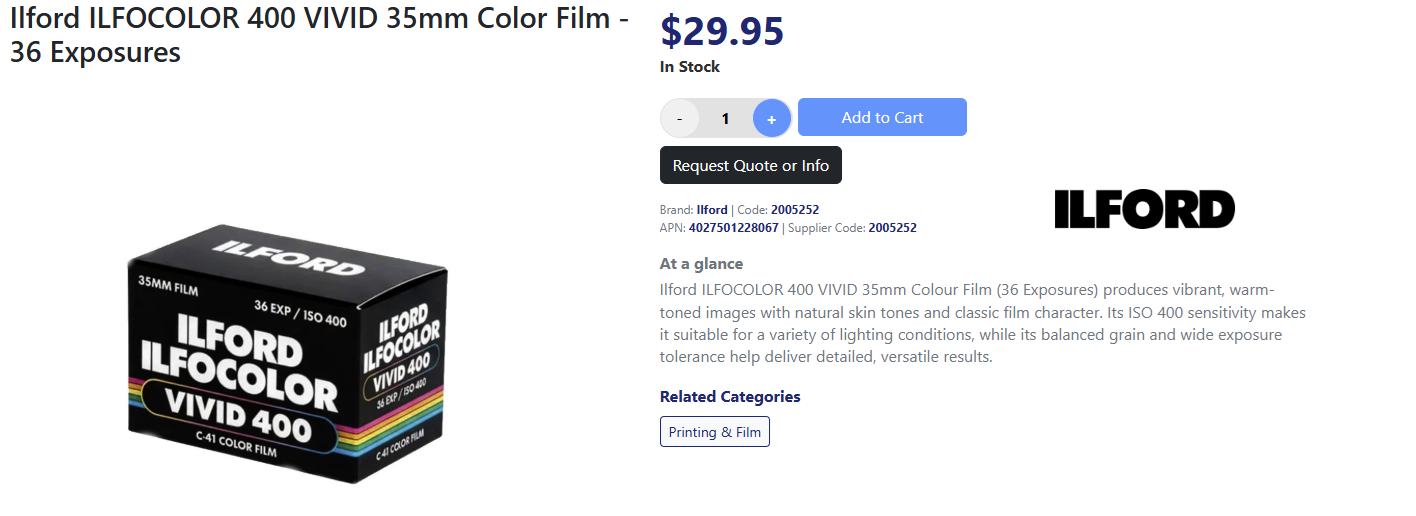
C.R. Kennedy sells a 36-exposure roll if “Vivid 400” for $29.95, while Kodak Ultramax 400 can be found for less than $20, an almost 50% difference.
Again, they may or may not be identical emulsions, but when you are charging that sort of money for a Kodak-manufactured film, telling the customer that Kodak manufactured it seems like fairly basic information.
Who makes Ilfocolor Vintage Tone 400?
Vintage Tone 400 follows the same basic formula, this time through Germany.
The film is manufactured by InovisCoat and sits within the same manufacturing world as the modern ORWO and Original Wolfen colour films produced alongside FilmoTec. It has repeatedly been associated with the Wolfen NC400 and NC500 family, although exactly which formulation Vintage Tone corresponds to is less important than the broader point.
At the time of writing, C.R. Kennedy’s Vintage Tone page does not tell customers that InovisCoat manufactures the film, nor does it identify FilmoTec or Original Wolfen as its source.

You get the Ilford name, some marketing about a vintage aesthetic and a product that sounds like a distinctive Ilfocolor creation, while the company that actually manufactured the film is nowhere to be seen.
The marketing doesn’t stop at the box
Part of what makes these films appear more established or distinctive than they really are is the amount of social-media promotion around them.
Like plenty of photographic brands, Ilfocolor sends film to photographers, creators and influencers to shoot and post about. There is nothing unusual about giving out review samples, but it is worth remembering that some of the enthusiastic posts you see about a new Ilfocolor release are coming from people who were given the film rather than choosing to spend $30 of their own money on a roll.
Free film is cheap marketing, particularly when the recipient already has an audience of film photographers. The product gets photographed, tagged, reviewed and circulated through the community, and the Ilford name gets another round of exposure.
None of that means the photographer doesn’t genuinely like the film, it just means there is an important difference between someone recommending a roll they went out and bought themselves and promotional coverage generated after a brand supplied the product for free.
If you actually want to support film, buy it from people making it
Film photography now depends on a tiny number of companies still willing and able to manufacture photographic film. If those coating lines disappear, there is nothing left for anyone to respool, repackage or wrap in clever branding.
So if you want Kodak film, buy Kodak.
If you like modern German colour stocks, buy Original Wolfen and support the InovisCoat and FilmoTec manufacturing ecosystem.
If you want to support the people who make HP5 while they invest in genuinely new colour-film technology, buy HARMAN Phoenix.
Those companies are doing the part of the industry that we think actually needs protecting.